Thursday, January 04, 2007

Cycling progress in the Netherlands


An article on Fietsniews (Bike News, December 29, 2006) in the Netherlands looks at some new developments for bike commuters: "The bike is faster on the commuter route between Delft and Pijnacker. Well, drivers ought to know about that. And they will, with posted comparisons of travel time along the way." Cyclists have been aware that they could outpace cars on this short (less than 4 km) drive from the small town of Pijnacker into the city of Delft. Bikeways along the road allow the cyclists to speed past traffic jams. "So for 2007, they're planning to flash digital comparisons of the travel times on the information signs. Cyclists and drivers can see with their own eyes who's fastest."

In another part of this project, "Wachttijdvoorspellers" (Waiting-time count-down clocks) are being added to the intersections with traffic lights, beginning with one at a busy intersection in Delft, and followed by 8 to 10 additional ones elsewhere along the route. This is primarily to improve safety for cyclists. Project spokesman Van Norden explains 'By predicting the waiting time, we encourage more cyclists to just wait for the light to turn green. This works particularly well with long wait times." (On this particular route, though, cyclists wait an average of only 15-20 seconds.

The photo is of a bike-path crossing in Hoorn, another city in the Netherlands. Here, a sensor was recently added so that cyclists and pedestrians don't have to push the button to activate the traffic light. Elsewhere in the Netherlands, some traffic sensors detect bikes approaching intersections so that the light turns green just as they get there. Thanks to Ligfiets.net for the link. The header above links to the Fietsniews article, in Dutch

Friday, December 29, 2006

60 Velomobiles

Velomobile enthusiasts celebrate the end of the year with the Oliebollentocht. This annual late-December ride in the Netherlands draws more velomobiles than any other, despite the challenges of darkness, ice, and snow. In 2006, the weather appears to have cooperated, and 60 velomobiles made it to the event.

Participants compete to post photos first, so this year's photo pages began appearing by the end of the rally day on December 28. The Dutch recumbent website assembles a list of links to the photos and reports.

Saturday, October 21, 2006

ASME Human Powered Vehicle Challenge (HPV)

An annual contest for mechanical engineering students features velomobile development, but it seems to exist in a separate universe from the velomobile manufacturing world. The word "velomobile" doesn't even appear in the announcement. (See the link in the header.)

"ASME sponsors the Human Powered Vehicle Competition in hopes of finding a design that can be used for everyday activities ranging from commuting to and from work to going to the grocery store. Senior engineering students can use this competition for their capstone project and with their efforts design and construct a fast, sleek, and safe vehicle capable of road use. "

"There are three different vehicle classes:

Single Rider - operated and powered by a single individual
Multi-rider - operated and powered by two or more individuals
Utility - vehicle designed for every-day transportation for such activities as commuting to work or school, shopping trips, and general transportation

The rider (or riders) can be in upright, prone or recumbent positions. The single and tandem vehicles compete in sprint and endurance events. The practical vehicle emphasizes the usefulness of the vehicle for daily activities such as shopping, transportation or recreation. The practical vehicles must negotiate a slalom course with the challenge of carrying packages, going over bumps, potholes or other obstacles while stopping at signs and obeying the rules of the road."

"All vehicles in all classes of competition are required to have a full or partial aerodynamic fairing. This fairing must cover 1/3 of the frontal area of the vehicle and be built such that it clearly shows the provided number assigned to the vehicle and ASME logo. "

Cycling enthusiasts should encourage more coverage of these events -- it's hard to find any information on past participants and their vehicles, and it would be nice to have more links between the engineering students and the actual users of existing velomobiles.

Friday, October 20, 2006

Short days and commuting


Minnesota winter sunlight lasts later into the evening than it does in northern Europe, but eventually commuters have to do something about visibillity. This "Down-Low Glow" light is what I gave my husband for his birthday this year. It would look good under a Cab-Bike, too.

Saturday, October 14, 2006

Back to Velomobiles


Getting back to velomobiles, since that's the topic of this blog, I've been uploading some velomobile film clips to YouTube. Click on the header for a link to the playlist. More to come when I get to them...

Thursday, October 12, 2006

Cool things to do on a bike


On a snowy day, I just learned how to upload a video to YouTube and embed it in this blog. This one is of the Haarlem Marching and Cycling Band, which biked and played for an hour or two at the 2006 Cycle Vision bike show and races in Zandvoort, Netherlands. There's a link to the band's website in the header.

Sunday, October 08, 2006

Retro Cycling

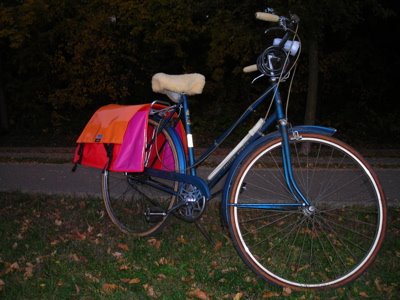
Back in about 1960, my dad bought this 1959 Raleigh for my mom, who had never owned a bike before. She decided recently that she was unlikely to ride it, and she gave it to me. This and my dad's Schwinn were the bikes I rode before buying my own Dunelt 3-speed in about 1962.

Last spring, we bought the panniers in the Netherlands, and then couldn't fit them onto any of our racks. European panniers are built for serious load-carrying. I had to buy a European rack that's about 5 centimeters longer than the U.S. standard -- but it's worth it. (The header links to Velox Europe, where we got these Clarijs panniers.)

So with a velomobile, a folding recumbent, a long-wheelbase recumbent and a Greenspeed trike, what on earth am I doing on a 1959 Raleigh? ...Biking! There aren't any bad bikes.

Monday, September 11, 2006

100 mile ride

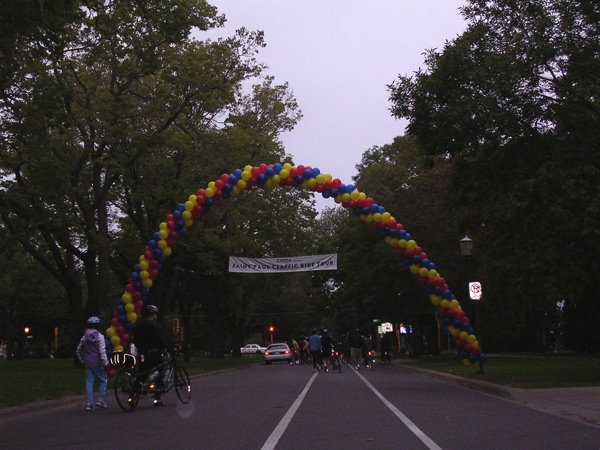
It's hard to know whether to brag about a 15-hour 100-mile ride. I watched Ymte Sijbrandij ride about 93 miles in three hours this spring, and Fast Freddy Markham went over 50 miles in an hour this summer. The guys in the Tour de France put in 100+ miles day after day. Still, I'm happy to be able to ride 100 miles in one day. This year, I did the ride on the day before my birthday because of the opportunity to combine it with two group rides. The St. Paul Classic normally attracts some 7000 riders, but a cold drizzle kept some of the crowds away this year. The Calhoun Cycle recumbent ride has exceeded 100 riders, but only a couple dozen showed up, and the ride was shortened. I rode our Greenspeed 20/20 GTO trike, averaging about 10 miles per hour, including rest stops, on the 30-mile route of the Classic. Dale and I rode over to Calhoun Cycle in the Cab-Bikes, getting in about 4 miles, but he had a sore foot, and I decided to switch back to the Greenspeed for further riding. The Cab-Bike felt slow and heavy after riding the Greenspeed. Oddly enough, I was actually not riding any slower, but open trikes just feel so fast. I didn't want to stress my knees on the hills by trying to keep up with lighter bikes. As it ended up, I missed the group and met them on the return loop. The last quarter of the 100-miles, I rode on the lake paths. Normally, they feel completely flat, but the little rises felt like mountains, and my speed dropped below 10 mph by the end of the ride. The odometer on the Greenspeed showed just over 100 miles when I pulled into the driveway. I had calculated that there was probably a 4% error, though; I figured that the 4 Cab-Bike miles would provide a guarantee that it was really a 100-mile day.

Tuesday, September 05, 2006

100 miles


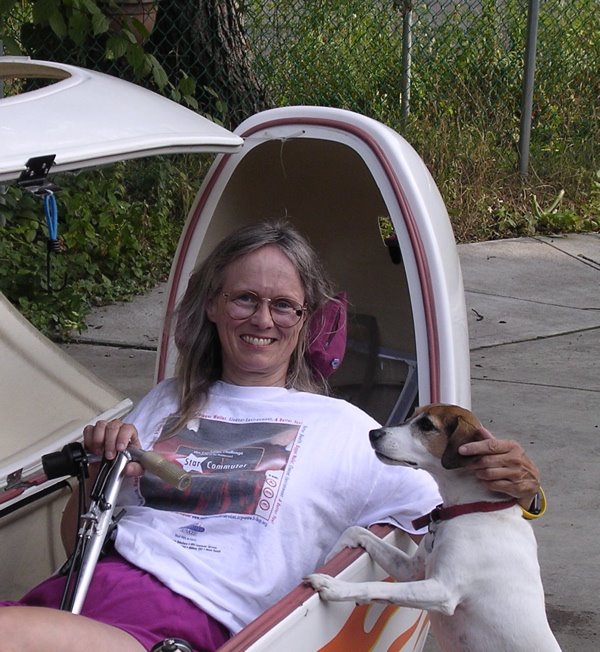
For the past two years, I've biked 100 miles on September 11. In 2004, it was in the Cab-Bike (see the photos; the odometer reads in kilometers), but in 2005, I used three different bikes. Riding a hundred miles takes me all day. I've only done it twice so far. It seemed like a good way to give my birthday a different focus after the events of 2001. This year, I'm planning to start the ride on September 10 and just finish it after midnight on the eleventh. There are two rides on the tenth that I didn't want to miss. The St. Paul Classic is a 7000-person tour of car-free streets in St. Paul, with plenty of music, food, and socializing. Riding there and back will bring that morning event to 50 miles. In the afternoon, Calhoun Cycle hosts a recumbent ride with as many as 100 riders that will add another 35 or 40 miles. A couple rounds of some local lakes will bring the total to 100. I'll probably start on a Greenspeed GTO trike, switch to the Cab-Bike for the Calhoun Cycle event, and end up with a 1959 Raleigh three-speed or a Brompton/Junik recumbent folder.

Thursday, June 15, 2006

Cycling in Paradise


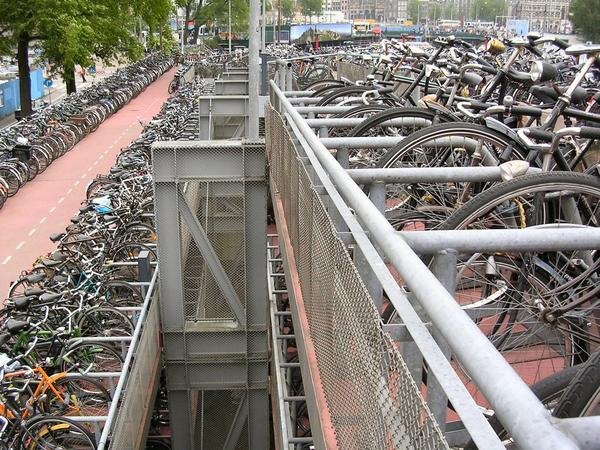
We're back from a bike trip that included riding in the Netherlands. We enjoyed separate bike paths along major intercity highways, signs for scenic and direct bike routes, traffic signals with sensors to detect cyclists and give them the green light, right-of-way and short-cuts for bikes, and this amazing bike parking ramp in central Amsterdam! Ordinary Dutch families were out cycling -- often all on one bike. Click on the title bar above ("Cycling in Paradise") for photos of family bikes and workbikes in Amsterdam.